
A free health check can help identify risks to your future health, often before you notice symptoms. What you receive depends on the service: an NHS appointment involves clinical measurements, while an online questionnaire helps you reflect on symptoms or risk factors without examining you.
This guide explains what to expect from the NHS Health Check in England, how access differs across the UK and what happens afterwards. A preventive check is not a substitute for investigating symptoms, so you do not need to wait for an invitation if something is worrying you.
Which type of health check are you being offered?
The NHS describes its Health Check as “a free check-up of your overall health”. Its main purpose is to assess your risk of cardiovascular disease and related conditions, then discuss ways to reduce that risk. It is not a comprehensive search for every possible illness.
There are three different services you may encounter:
| Type of check | What it involves | Main limitation |
|---|---|---|
| NHS Health Check in England | A preventive appointment using measurements, medical history and risk assessment | Eligibility rules apply and it does not test for every condition |
| Online self-assessment | Questions about symptoms, habits or risk factors | Cannot measure blood pressure, analyse blood or confirm a diagnosis |
| Private health assessment | A paid package whose contents vary by provider | More tests do not necessarily mean more useful information |
If you are using an online tool, check what its result actually means. Our explanation of how screening tools help you understand your health covers why a screening score is a starting point rather than a diagnosis.
Who can get a free health check?
In England, the NHS Health Check is generally offered every five years to eligible adults aged 40 to 74 who do not already have certain cardiovascular or related conditions. You do not need to feel unwell to benefit.
Existing diagnoses can change the appropriate route. For example, someone with diabetes, heart disease, chronic kidney disease or high blood pressure will usually need ongoing condition reviews rather than this preventive programme. People already taking statins are also generally outside its eligibility criteria. Your practice can confirm your position.
These exclusions do not mean you are being denied care. A condition review can focus on the monitoring, medicines and treatment targets relevant to your existing diagnosis.
Being younger than 40 or older than 74 does not prevent you from asking a GP about symptoms, family history or a specific health concern. It means the standard programme may not be the right service for you.
Does the same programme operate across the UK?
The England programme should not be assumed to apply throughout the UK.
| Where you live | What to expect |
|---|---|
| England | The NHS Health Check programme has defined age and eligibility criteria, with local delivery arrangements |
| Scotland | Preventive care and local health initiatives differ; ask your GP practice about suitable assessments |
| Wales | Ask your GP practice or local health board about available checks and risk assessments |
| Northern Ireland | Your GP practice can advise on preventive care and locally available services |
Outside England, access to a free health check depends on the assessment you need and the services available locally. Routine screening programmes, such as bowel or cervical screening, also have their own eligibility rules and invitations.
How to book and prepare
In England, your GP practice or local council may invite you when you are eligible. Appointments may take place at a GP surgery, a participating pharmacy or another community venue, depending on local arrangements.
If you think you qualify but have not heard anything, ask your practice or check your council’s website. To arrange a free health check, you should not normally need to buy a private package or pay for an online questionnaire first.
Before attending, have an up-to-date list of medicines ready, including prescribed treatments and supplements. It also helps to know whether close relatives developed heart disease or had a stroke at a relatively young age.
Ask whether any blood test requires fasting rather than assuming you must skip breakfast. Do not stop your usual medicines unless your clinician tells you to. Mention any accessibility needs, interpreter requirements or anxiety about blood tests when booking.
Bring up current symptoms at the outset. The clinician may recommend a separate appointment because assessing an existing problem requires a different approach from estimating future risk.
What happens during the appointment?
The NHS says the appointment usually takes about 20 to 30 minutes. You will discuss your health and lifestyle, have some measurements taken and receive an explanation of the findings. Some services arrange blood tests before the main appointment.
A free health check usually combines the following elements, although the exact process varies locally:
| Part of the appointment | What it helps assess |
|---|---|
| Medical and family history | Existing conditions, medicines and inherited risk factors |
| Smoking, alcohol and physical activity questions | Habits that can affect future health and areas where support may help |
| Height, weight and sometimes waist measurement | Body mass index and weight-related health risks |
| Blood pressure measurement | Whether your reading needs further assessment |
| Cholesterol test | Blood fats used alongside other information to estimate cardiovascular risk |
| Diabetes risk assessment | Whether further blood testing for type 2 diabetes is appropriate |
Cholesterol testing may use a finger-prick sample or blood taken from a vein. A diabetes blood test is not automatically necessary for everyone; the decision depends on your risk and the local process.
Kidney function tests may also be arranged when indicated, but a full laboratory panel is not a standard entitlement for every attendee. Ask which tests you are having and what question each one is intended to answer.
Understanding your results and risk score
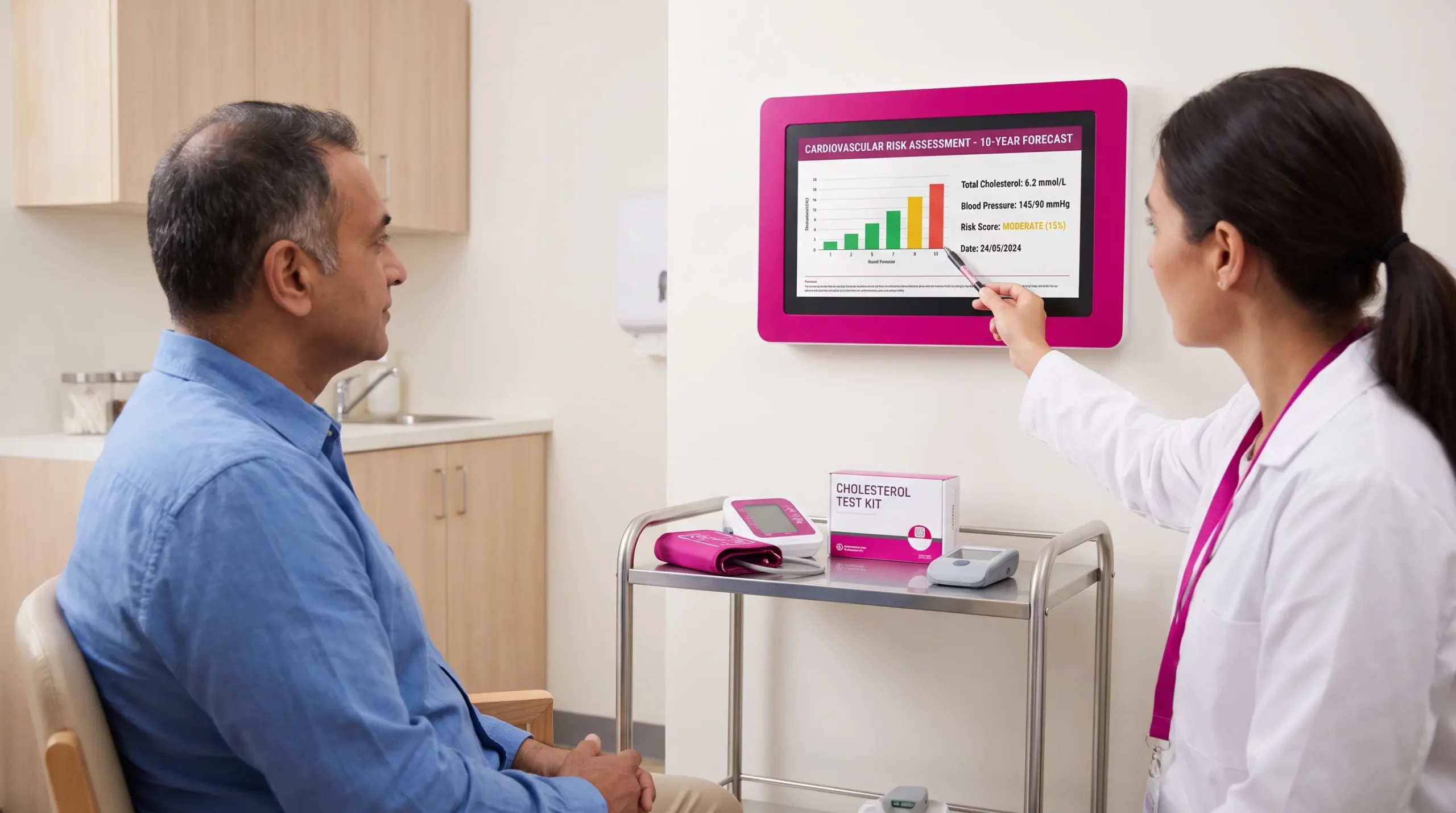
Your clinician should explain the measurements individually and what they mean together. A single raised blood pressure reading does not usually confirm hypertension; repeat measurements, home monitoring or a 24-hour monitor may be needed.
For many attendees, a key result is an estimate of cardiovascular risk over the next ten years, often calculated using QRISK3. This combines factors such as age, blood pressure, cholesterol, smoking and medical history.
For example, a 10% ten-year cardiovascular risk means that, among 100 people with similar risk factors, around 10 would be expected to develop cardiovascular disease over that period. It does not predict exactly what will happen to you.
The value of a free health check is in turning those findings into a practical plan, rather than simply labelling a score “good” or “bad”.
NICE, which publishes clinical guidance, states: “Offer atorvastatin 20 mg for the primary prevention of CVD to people who have a 10-year QRISK3 score of 10% or more.” This is guidance for a clinician-led discussion, not an instruction to start medication yourself. Your preferences, other conditions, potential benefits and possible side effects should all be considered.
Ask for a copy of your results and an explanation of anything you do not understand.
What the check does not screen for
An NHS appointment is not a “full body MOT”. It does not routinely include scans, an ECG, thyroid tests, vitamin levels or screening for every cancer. Sexual health tests and assessments of specific symptoms usually require separate arrangements.
A free health check also does not routinely include PSA testing for prostate cancer. If you have concerns about your prostate, urinary symptoms or a relevant family history, discuss them with your GP rather than assuming a general appointment covers them.
Other screening invitations remain important even after reassuring results. Cervical, breast and bowel screening follow separate programmes and should not be replaced by a general assessment.
Oral health needs a separate dental appointment too. This overview of what a dental check-up may include explains why examinations, gum assessments and any X-rays depend on individual needs. It is an Australian resource, so UK access arrangements and charges differ.
Before paying for additional private tests, ask how a result would change your care. Testing without a clear reason can produce incidental findings, false alarms or false reassurance.
What happens after the appointment?
Your next step may be lifestyle support, further testing, a routine GP appointment or a discussion about medication. Advice should fit your circumstances, including disability, existing illness, finances and caring responsibilities.
Choose manageable priorities with your clinician rather than trying to change everything at once. That might mean accessing stop-smoking support, agreeing a realistic activity plan or arranging repeat blood pressure measurements.
Before leaving a free health check, make sure you know who will review outstanding results and when. Ask whether you need to book the follow-up yourself and what to do if you hear nothing.
Do not wait for the next five-year invitation if your health changes. Persistent symptoms, unexplained weight loss or unusual bleeding need medical advice even after reassuring results. Call 999 for signs of a heart attack or stroke, such as severe chest pain or sudden facial drooping, arm weakness and speech difficulty.
Frequently asked questions
Can I get a free health check if I am over 50? Yes, if you live in England and meet the NHS programme’s criteria. People aged 50 to 74 may qualify, but existing conditions, relevant medicines and the timing of previous checks can affect eligibility. Ask your GP practice to confirm.
Can I get a blood test for free in the UK? Blood tests are generally available through the NHS when clinically indicated. A GP decides which tests are appropriate for your symptoms, risk factors or monitoring needs. There is no universal entitlement to every blood test on request.
Does an NHS Health Check include prostate screening? No. PSA testing is a separate decision involving discussion of its benefits and limitations. Men aged 50 or over can ask their GP about an NHS PSA test, while symptoms or increased risk may warrant an earlier conversation.
How do I get a full health check? Start by explaining what you want assessed. A preventive review, investigation of symptoms and monitoring of an existing condition serve different purposes. No single appointment or blood-test package can reliably rule out every disease.
Can an online quiz replace an appointment? No. Online assessments can help identify concerns to discuss, but they cannot perform an examination or confirm a diagnosis. A reassuring score should never override persistent symptoms or a clinician’s advice.
References
- NHS: NHS Health Check, programme purpose and eligibility.
- NHS: What happens at an NHS Health Check?, appointment length, measurements and results.
- NICE NG238: Cardiovascular disease risk assessment and lipid modification, cardiovascular risk assessment and preventive treatment recommendations.
- NHS: PSA testing, access to testing and its limitations.
Choose the right next step
If you are considering a free health check, ask your GP practice which service fits your age, history and concerns. For a private starting point at home, explore HealthTest’s free online health assessments, which provide immediate screening results to help guide your next steps, not diagnose a condition.
Have a question about using the website? Contact HealthTest for website-related enquiries. Questions about symptoms, test results or treatment should go to an appropriate healthcare professional.