
A mental health test can help you recognise symptoms, put difficult feelings into words and decide whether to seek support. It cannot confirm a diagnosis, explain everything behind your symptoms or prove that you do not need help. The most useful way to treat a result is as a starting point for a conversation, not a verdict about your health.
That distinction matters whether your score feels reassuring, worrying or completely at odds with your experience. A questionnaire captures the answers you give within a particular timeframe. It does not capture your whole history, circumstances or ability to cope.
This guide focuses on the decisions a result can reasonably support, the conclusions it cannot justify and what to do when the score and your experience disagree.
If you are in immediate danger or cannot keep yourself or someone else safe, call 999 or go to A&E. Do not wait for a questionnaire result.
What a mental health test can tell you
A screening questionnaire can identify symptoms associated with the condition it was designed to check. For example, the PHQ-9 asks about depressive symptoms, while the GAD-7 focuses on anxiety symptoms. Both ask about the previous two weeks.
Depending on the questionnaire, your answers may help you notice changes in sleep, mood, concentration or enjoyment. They can also give you a structured way to explain experiences that otherwise feel vague or difficult to discuss.
Useful conclusions include recognising that symptoms are occurring frequently, noticing that they are affecting daily life or deciding that a professional conversation would be worthwhile. None requires you to give yourself a diagnostic label.
The World Health Organization describes mental health as “more than the absence of mental disorders”. A questionnaire focused on one condition therefore cannot measure every aspect of your wellbeing. A low anxiety score, for instance, says little about loneliness, relationship difficulties or symptoms the questionnaire never asked about.
What a result cannot establish
A diagnosis or the cause of your symptoms
A mental health test cannot reliably distinguish every condition that may produce similar answers. Poor concentration, fatigue and disrupted sleep can occur with depression, anxiety, physical illness, medication effects or difficult life circumstances.
A clinician also considers duration, previous episodes, changes from your usual functioning and other possible explanations. NICE’s depression guideline advises: “Conduct a comprehensive assessment that does not rely simply on a symptom count.”
Someone experiencing bereavement and someone with recurrent depression might give similar questionnaire answers but need different conversations and support. The score alone cannot resolve that difference.
It also cannot select the right treatment, determine whether medication is suitable or tell you to stop a prescribed medicine. Those decisions need an individual assessment with an appropriately qualified professional.
Your safety, future or fitness for work
A questionnaire cannot guarantee that you are safe because your total is low. It also cannot reliably predict whether symptoms will worsen or how quickly you will recover. Any answer about self-harm or suicide needs attention in its own right, not just as part of a total.
Nor is an online self-check a certificate of fitness for work or a formal report for legal proceedings. This guide to mental health evaluations for court and work explains the different purpose of structured professional evaluations. Requirements vary by jurisdiction, so UK readers should confirm which qualifications, report format and consent arrangements the requesting organisation accepts.
A screenshot from a free quiz should not be assumed to satisfy an employer, court or occupational health requirement.
How much confidence should you put in a score?
A mental health test is more useful when its questionnaire has been validated for the intended purpose and population. Validation means researchers have examined how the tool performs against an appropriate comparison, not that every individual result is correct.
For context, the original 2001 PHQ-9 validation study reported 88% sensitivity and 88% specificity for major depression at a score threshold of 10. Sensitivity describes how well a tool identifies people who have the condition. Specificity describes how well it identifies people who do not.
Those figures do not mean that someone scoring above that threshold has an 88% chance of having depression. They also should not be applied to every online quiz. Performance depends on the setting, population and threshold used.
False positives and false negatives remain possible. A positive result may flag symptoms without confirming the condition, while a negative result may miss someone who needs support.
For more detail on scoring, see HealthTest’s explanation of how screening questionnaires work and what their results mean. The practical rule is to consider your score alongside your experience, not instead of it.
What to do with different kinds of results
The next step after a mental health test should depend on your symptoms, their impact and any safety concerns, rather than the score alone.
| Your result and experience | What you can reasonably conclude | A useful next step |
|---|---|---|
| An elevated score with ongoing difficulties | The questionnaire has identified symptoms worth discussing | Arrange a GP appointment and bring examples of their impact |
| A low score, but you are struggling | The result has not explained your difficulties | Seek advice rather than dismissing your experience |
| A high score during a particularly difficult period | You are reporting substantial symptoms now, but the cause remains unclear | Discuss the circumstances, duration and support you need |
| Noticeably different scores over time | Your answers have changed, but the reason needs context | Compare timeframes and circumstances rather than assuming recovery or deterioration |
| Thoughts of self-harm or suicide at any score | Safety needs attention separately from the total | Seek prompt support, using emergency services if there is immediate danger |
You do not need to reach a particular score before booking a GP appointment. Persistent distress, difficulty managing everyday tasks or concern from someone who knows you well can be enough reason to ask for help.
When support should not wait
In England, call NHS 111 and select the mental health option if you need urgent mental health support but it is not an emergency. Elsewhere in the UK, use your local NHS urgent mental health service.
Samaritans is available free on 116 123, day or night, if you need someone to talk to. This does not replace emergency help when there is immediate danger.
New experiences such as hearing voices, or unusually high energy with very little sleep and risky behaviour, also deserve prompt clinical assessment. Do not rely on a depression or anxiety score to decide whether these experiences matter.
What a clinician can add that a questionnaire cannot
A clinical assessment is a conversation, not simply a longer quiz. A GP or mental health professional may explore when symptoms started, what makes them better or worse and how they affect relationships, work, study or self-care.
They may ask about previous episodes, periods of unusually elevated mood, alcohol or drug use, medicines and physical health. These questions help distinguish between explanations that can look similar on a symptom checklist.
There is no single blood test that diagnoses depression or anxiety. However, a GP may arrange investigations where your symptoms suggest a possible physical contributor, such as thyroid disease or anaemia.
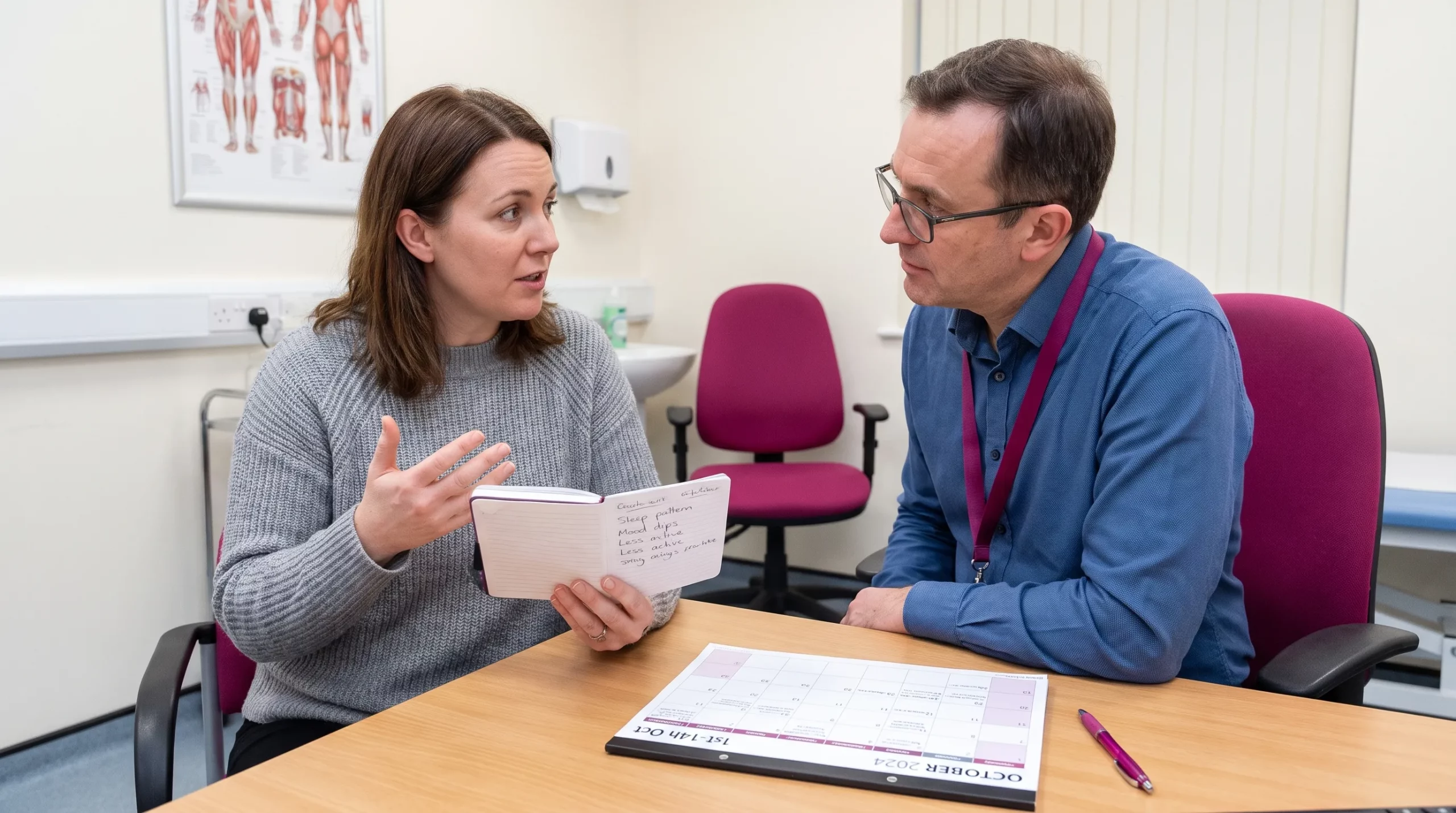
You can make that conversation more useful by describing concrete changes: missing shifts, avoiding friends, struggling to prepare meals or waking repeatedly at night. Bring your questionnaire answers if helpful, but do not worry if you have no score to show.
You can also say that a question did not fit your experience, or that you found it difficult to answer honestly. That context matters.
How to make a self-check more useful
Before completing a questionnaire, check what it measures and who it is intended for. A tool developed for adults may not be suitable for a child, and a condition-specific quiz is not a general assessment of every mental health difficulty.
A few habits can make the exercise more useful:
- Follow the stated timeframe: Answer about the period requested, rather than only your best or worst day.
- Use your own experience: Choose answers that reflect how you have actually felt, not what you think you should say.
- Record the impact: Note one or two examples of how symptoms affect your daily life.
- Check privacy information: Understand whether answers are stored, who can access them and whether you need to create an account.
Repeating a mental health test several times in one evening is unlikely to clarify your situation. It may instead become a search for reassurance. If you repeat a questionnaire, follow any recommended interval and consider changes in circumstances as well as the total.
Do not postpone an appointment while waiting for a clearer result. A brief written account of what is troubling you can be just as useful a starting point.
References
- World Health Organization: Mental health: strengthening our response, including its explanation of mental health and wellbeing.
- NICE: Depression in adults: treatment and management, recommendations, including comprehensive assessment rather than symptom counting alone.
- Kroenke K, Spitzer RL and Williams JBW: The PHQ-9: Validity of a Brief Depression Severity Measure, Journal of General Internal Medicine, 2001.
- NHS: Where to get urgent help for mental health, including emergency and urgent support routes.
Frequently asked questions
Can an online mental health test diagnose a condition? No. A screening questionnaire can identify symptoms that warrant further assessment, but diagnosis requires clinical judgement and relevant context. Some questionnaires are also used by professionals to monitor symptoms after a diagnosis.
What are five signs that you may need mental health support? Persistent low mood, excessive worry, significant sleep changes, withdrawing from others and difficulty managing everyday tasks are five possible signs. They are not a diagnostic checklist, and other changes can matter too. Duration, severity and impact help determine the support you need.
Should I see a GP if my result is low? Yes, if you remain concerned. A low score does not cancel out distress or difficulties that the questionnaire missed. Describe what has changed and how it affects you, even if you cannot name a condition.
Does a higher score mean I will need medication? No. Treatment decisions depend on a fuller assessment, your preferences, previous treatment and the nature of your difficulties. Support may involve psychological treatment, practical changes, medication or a combination, depending on your needs.
Take a first step without treating the score as a verdict
If you would like a structured starting point, explore HealthTest’s free health self-assessments. A mental health test can help you organise your concerns, but its result is guidance rather than a diagnosis.
For questions about using the website, contact HealthTest. For personal medical advice, speak to your GP or another qualified healthcare professional. If you need urgent support, use the NHS and emergency routes above rather than waiting for a website enquiry response.