
Searching for mens help can bring up everything from walking groups to crisis helplines, leaving you unsure which option actually fits. You might want somewhere to talk, a reason to get out of the house or support with a particular problem. Those needs do not all call for the same service.
The right group should feel respectful, have clear boundaries and be practical enough for you to attend. You do not need a diagnosis, a dramatic story or the confidence to speak straight away. This guide will help you compare options before committing.
If you need support today
Do not wait for a group meeting if you need urgent help. If you have seriously harmed yourself, someone’s life is at risk or you cannot keep yourself or someone else safe, call 999 or go to A&E.
For urgent mental health support without immediate danger, contact your GP or your nation’s NHS urgent-care service. In England, call 111 and select the mental health option. The NHS states: “A mental health emergency should be taken as seriously as a medical emergency.” [1]
If you need someone to listen, you can call Samaritans free on 116 123, day or night. You do not have to be suicidal to call.
A peer group can provide ongoing connection, but it is not a substitute for emergency care.
What kind of mens help do you need?
Start with what you want support to change. “I want to feel less alone” points towards a different setting from “I need treatment for panic attacks” or “I’m frightened of my partner”.
Mind defines peer support simply: “Peer support is when people use their own experiences to help each other.” [2] That shared experience can be valuable, but it is different from assessment or treatment by a healthcare professional.
| What you need | An option to explore | What to check |
|---|---|---|
| Company and a regular reason to leave home | Walking, activity or community groups | Whether conversation is optional and the activity suits your abilities |
| Space to discuss difficult experiences | Facilitated peer support | Group rules, facilitator preparation and confidentiality limits |
| Help understanding persistent symptoms | GP appointment or an appropriate mental health service | How assessment works and what treatment may be available |
| Support with bereavement, addiction or abuse | A specialist service or group | Whether it has experience of your particular situation |
| Someone to listen now | A listening helpline | Opening hours and whether it offers listening, advice or crisis support |
When comparing mens help options, remember that these routes can work together. You can attend a community group while seeing your GP or receiving therapy. Choosing a group does not mean giving up professional care.
Check how the group is run
A friendly description is useful, but it does not tell you everything about safety. Before attending, ask who organises the group, who facilitates sessions and what happens if someone becomes distressed.
Look for clear boundaries
A responsible organiser should be able to explain its rules in ordinary language. Ask about confidentiality, respectful behaviour and the circumstances in which safeguarding concerns might need to be shared.
Confidentiality is not the same as an absolute guarantee of secrecy. Organisers cannot fully control what every participant says outside a meeting. Online groups also need clear rules about screenshots, recordings and sharing identifying information.
Find out whether members exchange contact details and whether private messages between participants are encouraged, optional or restricted. You should not feel pushed into friendships or contact outside the group.
Distinguish experience from clinical expertise
A facilitator may bring valuable lived experience without being a therapist. Ask what preparation they receive, what support they have and how they respond when someone needs help beyond the group’s scope.
When searching for mens help, be cautious about promises to cure depression, instructions to stop prescribed medication or pressure to buy expensive programmes. Humiliation, aggressive confrontation and demands to disclose traumatic experiences are also reasons to step back.
Our explanation of how men support one another through peer groups explores the role of listening and shared experience. When choosing a particular group, check how those principles work in practice.
Decide whether the setting suits you
A well-run group can still be the wrong fit. You might prefer a small discussion circle, a walk where conversation happens naturally or an activity that gives you something to do with your hands.
Consider who attends and what is expected
Check the age range and eligibility rather than assuming that “men’s group” means everyone can attend. Ask how the group welcomes trans men, disabled men or people from your cultural background if that matters to your comfort and safety.
Find out whether faith, spirituality or a particular approach to masculinity shapes the sessions. These may suit some people and not others. The organiser should describe its approach without pressuring you to agree with it.
Ask whether you can listen during your first visit, leave early or take a break. A predictable session can feel easier to approach than an invitation to “just turn up and open up”.
Check the practical details
A mens help option is only useful if you can realistically access it. Consider travel, step-free access, toilets, childcare, shift patterns and any fees or suggested donations.
Some checks apply across healthcare settings. Advice on choosing the right dentist highlights convenience and getting to know the staff, both useful considerations when approaching an unfamiliar service. For support groups, add questions about facilitation and safeguarding.
For online meetings, check whether cameras are optional, whether headphones are recommended and whether you have somewhere private to join. Online access removes travel, but not every privacy barrier.
Find local and online options without guessing
Use a postcode-based directory such as Hub of Hope to identify nearby mental health support. Then check each organisation’s own information. A directory listing is a starting point, not confirmation that a service is currently running or suitable for you.
Searching for mens help by postcode can uncover smaller community options alongside national organisations. Your GP practice, council, library or local voluntary-sector directory may also know about groups that are not prominent in search results.
Two different approaches worth comparing are ANDYSMANCLUB, which offers peer support groups for men aged 18 and over, and the UK Men’s Sheds Association directory, which helps people find community spaces centred on making and practical activities. A Shed is not necessarily a mental health discussion group, so ask what the local setting offers.
Before travelling, confirm the current venue, meeting time, eligibility and joining arrangements. Some groups accept people without a referral, while others require registration, an introductory conversation or a professional referral. Do not assume every group is free.
If nothing nearby fits, look for facilitated online groups. Check who can join, how the meeting link is protected and whether the group supports people in your part of the UK.
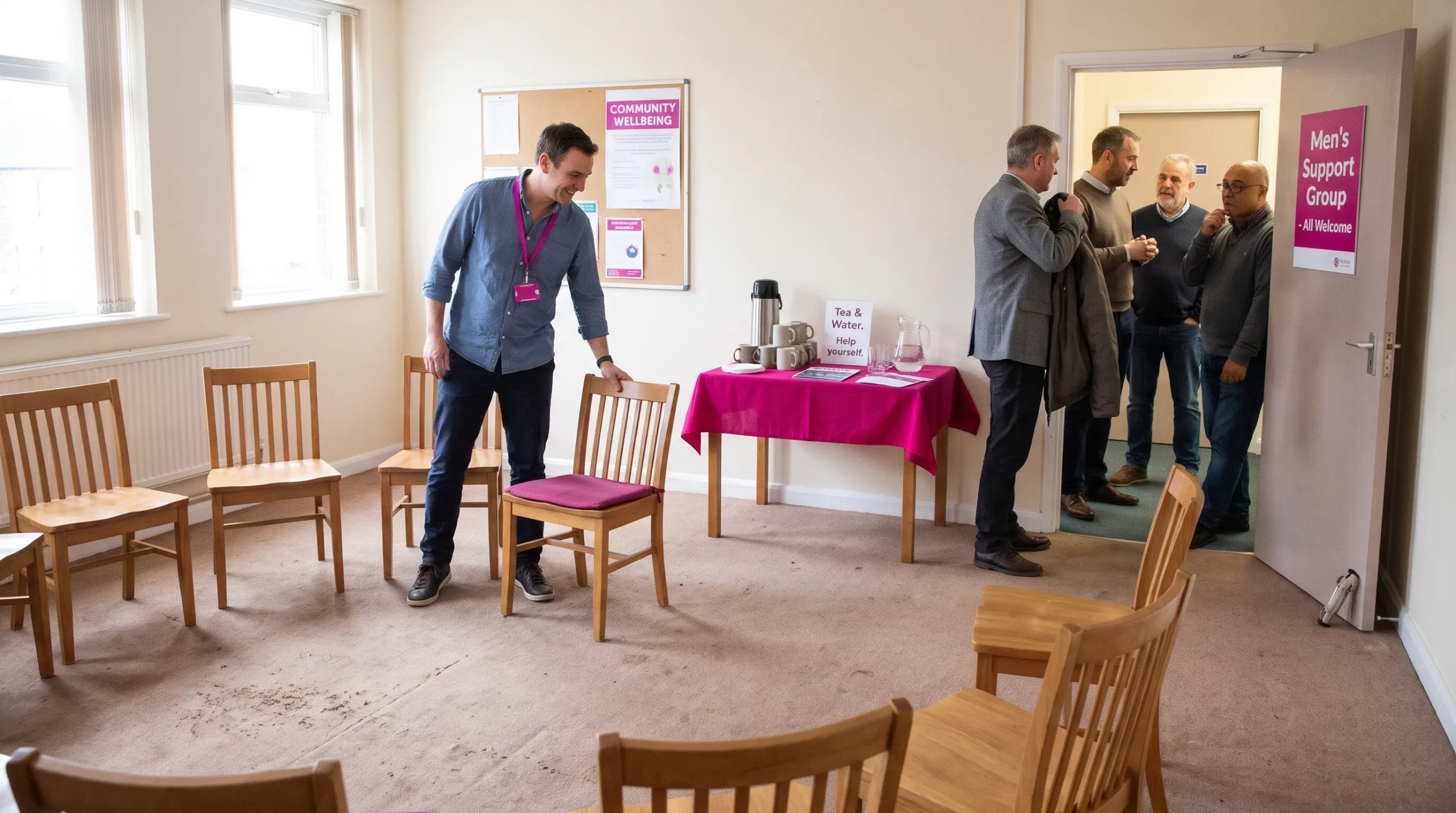
Make first contact before deciding
You can ask questions without agreeing to attend. A short email or call may give you a better sense of the group than a page of testimonials.
Try: “I’m thinking about coming, but I’m nervous about speaking. Could you tell me what a first session involves and whether I can mostly listen?”
Useful questions include:
- Who is the group for? Ask about eligibility and whether it regularly supports people with concerns like yours.
- What happens during a session? Check the format, length and expectations around speaking.
- How is safety handled? Ask about confidentiality, safeguarding and how disruptive behaviour is managed.
- What does joining involve? Confirm registration, referrals, waiting lists and any costs.
- Can I speak to someone beforehand? A brief introduction may make arriving easier.
Notice how the organiser responds. A clear, considerate answer matters more than a polished sales pitch. It is reasonable for a volunteer-led group to take time to reply, but unanswered safety questions should not be brushed aside.
You do not owe a mens help service your full history before finding out whether it suits you. Share only what is needed to establish eligibility and discuss access needs. Avoid sending detailed medical information through public social-media comments.
Treat the first visit as a trial, not a commitment
If the setting feels safe, give yourself permission to observe rather than perform. Feeling awkward during a first meeting does not automatically mean the group is wrong for you.
Afterwards, consider whether people listened without competing, whether differences were treated respectfully and whether the facilitator maintained boundaries. You may feel tired after an emotional discussion, but you should not have been pressured, mocked or threatened.
Distinguish ordinary unfamiliarity from a genuine mismatch. A quieter group may become comfortable after another visit. Repeated interruptions, discriminatory comments or pressure to disclose are not problems you need to tolerate while waiting to settle in.
The right mens help setting may take more than one attempt to find. You can try a different format, change groups or decide that individual support would suit you better. If the experience leaves you significantly distressed, speak with someone you trust or a healthcare professional rather than relying on the next meeting alone.
Know when a GP or specialist service is the better next step
Persistent low mood, anxiety, sleep disruption, increasing alcohol use or difficulty managing everyday responsibilities deserve attention, even if you are also attending a group. A GP can assess symptoms, consider physical causes and discuss treatment or referral options.
The Office for National Statistics reported that males accounted for around three-quarters of suicides registered in England and Wales in 2023. [3] This is a population-level statistic, not a prediction about any individual. You do not need to reach a crisis before seeking care.
If you are unsure whether changes go beyond everyday stress, our guide to recognising mental health difficulties and finding support explains when assessment may help.
A general mens help group may not have the expertise needed for domestic abuse, trauma or substance dependence. For example, ManKind Initiative provides information and support for male victims of domestic abuse. Check current contact arrangements and use a safe device if someone monitors your communications. Call 999 if there is immediate danger.
Frequently asked questions
Do I need a diagnosis to join a men’s support group? Many community and peer groups do not require one, but eligibility varies. Some specialist groups support people with a particular condition or experience. Ask the organiser before attending.
Will I have to talk about my feelings immediately? Not necessarily. Some groups let newcomers listen, while others use structured check-ins. Ask what is expected and whether you can pass on a question. You should not be forced to disclose personal experiences.
Can I attend a group while having therapy or taking medication? Often, yes. Peer support can sit alongside treatment, but it does not replace clinical advice. Discuss treatment changes with your prescriber or treating professional, not solely with group members.
How do I know whether an online group is trustworthy? Look for an identifiable organiser, clear moderation, privacy rules and a safeguarding process. Be cautious if members are pressured to pay, reveal sensitive details or move into unmonitored private conversations.
References
1. NHS: Where to get urgent help for mental health. Emergency guidance and the NHS quotation used above.
2. Mind: About peer support. Definition and explanation of peer support.
3. Office for National Statistics: Suicides in England and Wales: 2023 registrations. The statistic refers to deaths registered in 2023, not necessarily deaths occurring that year.
Take a manageable next step
If your mens help search has left you unsure how to describe what is happening, a free HealthTest screening quiz can help you reflect on possible signs of a physical or mental health condition. Results are immediate and intended to guide next steps, not provide a diagnosis or replace medical advice.
For questions about the quizzes, contact HealthTest. For urgent concerns, use the NHS or emergency routes above rather than waiting for a website response.